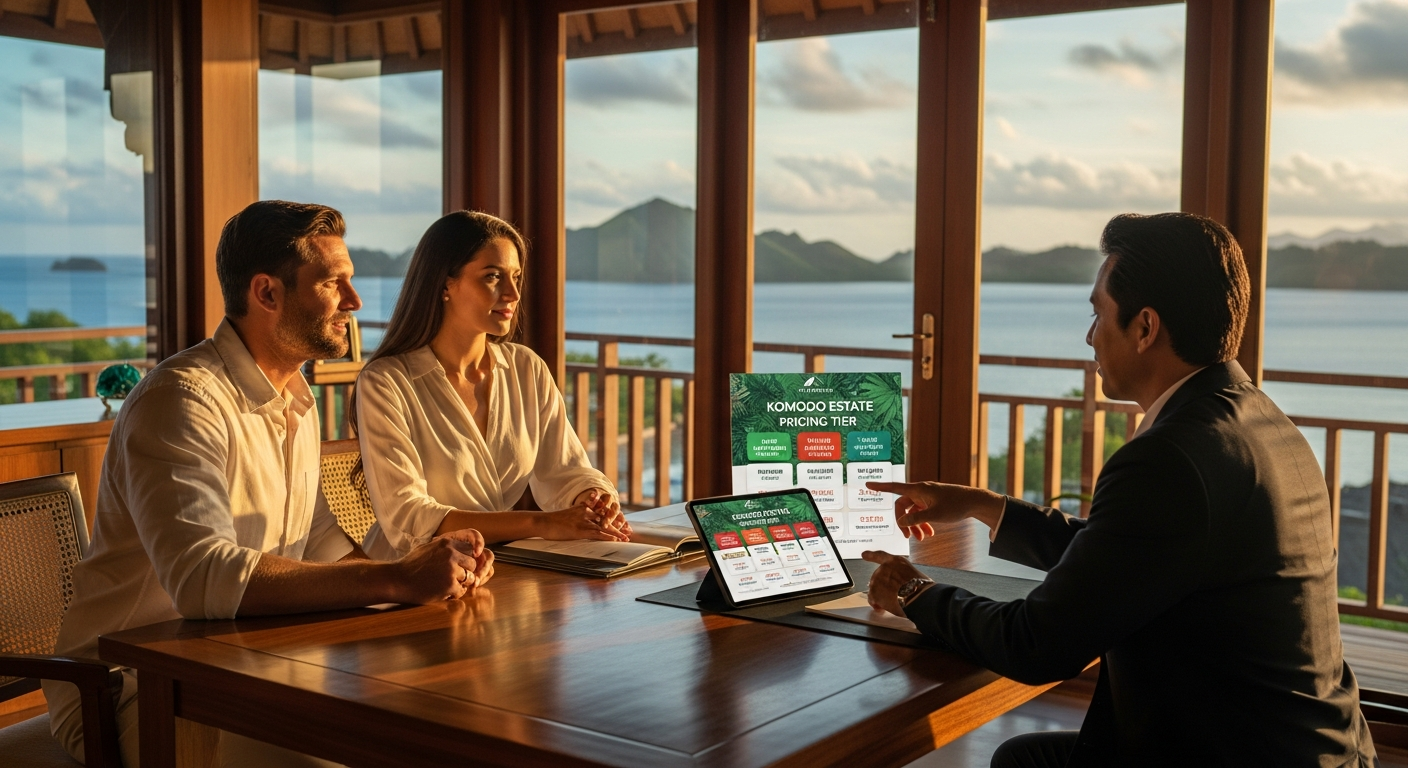
- Labuan Bajo waterfront land: $1,500-$2,500/sqm.
- Luxury villa construction: $1,500-$5,000/sqm.
- Private island leasehold: $5M-$20M for multi-hectare plots.
The morning light spills across the Labuan Bajo harbor, illuminating superyachts anchored alongside traditional phinisi vessels. This is the gateway to Komodo National Park, a UNESCO World Heritage Site, and the epicenter of Indonesia’s luxury tourism boom. Here, the calculus of investment is precise, driven by a landscape of exceptional natural beauty and a government mandate for elevated hospitality.
Understanding the Komodo Estate Investment Landscape
The investment in a Komodo estate is a strategic acquisition, positioned within one of Southeast Asia’s fastest-growing luxury tourism corridors. Labuan Bajo, the capital of West Manggarai Regency, serves as the primary hub, its Komodo Airport (LBJ) now handling direct flights from Jakarta (2.5 hours) and Bali (1 hour). This accessibility underpins a significant valuation uplift for prime assets. Since its designation as one of Indonesia’s five “Super Priority Tourism Destinations” in 2019, Labuan Bajo has seen infrastructure investment exceeding IDR 20 trillion (approximately $1.3 billion USD), transforming its urban fabric and connectivity.
Land appreciation rates in key areas like the Labuan Bajo waterfront have registered annual increases of 10-20% over the last five years. The region’s appeal extends beyond its iconic Komodo dragons; it encompasses pristine dive sites, untouched islands, and a burgeoning culinary scene. The Indonesian government, through entities like the Badan Pelaksana Otorita Labuan Bajo Flores (BPOLBF), actively promotes high-value, low-impact tourism, signaling a clear trajectory for luxury development. This policy framework, combined with finite land availability, creates a compelling environment for capital growth. Investors targeting a Komodo estate are not merely acquiring property; they are securing a stake in a controlled, upscale expansion of a globally significant destination. The Komodo National Park, established in 1980, spans over 1,733 square kilometers, with strict conservation policies influencing surrounding development. This ensures exclusivity and protects the long-term value of adjacent private holdings.
Land Acquisition Tiers: Labuan Bajo Waterfront to Private Islands
Acquiring land for a Komodo estate involves navigating distinct value tiers, each defined by location, topography, and development potential. At the apex are the highly sought-after Labuan Bajo waterfront plots. These command prices typically ranging from $1,500 to $2,500 per square meter for plots between 500 sqm and 2,000 sqm, often with existing infrastructure access. The demand for these parcels, offering direct ocean access and panoramic views of the Flores Sea, remains consistently high. Moving slightly eastward, areas like Wae Cicu, approximately 10 kilometers from Komodo Airport, present premium beachfront opportunities. Here, land prices for parcels of 1,000 sqm to 5,000 sqm generally fall between $800 and $1,200 per square meter, offering a balance of proximity and seclusion.
Further afield, the Pede and Binongko areas, known for their developing hospitality zones, offer oceanview and clifftop plots at $600 to $900 per square meter. These locations, often less than 20 minutes from the town center, are ideal for boutique resorts or larger private villas. For those seeking greater elevation and expansive vistas, the Sernaru highlands, about 30 minutes drive inland, offer land at $400 to $700 per square meter for plots exceeding 5,000 sqm. These elevated sites provide cooler climates and often feature 270-degree ocean panoramas. The pinnacle of Komodo estate acquisition, however, involves private island leaseholds within the broader Komodo archipelago. These multi-hectare parcels, typically ranging from 5 to 50 hectares, are secured via long-term lease agreements (e.g., 25+25 years) and represent investments between $5 million and $20 million, depending on size, existing permits, and proximity to major islands like Rinca or Komodo. These opportunities, often requiring significant capital for infrastructure development, are reserved for ultra-high-net-worth individuals and international resort operators seeking exceptional exclusivity.
Villa Development Costs: Bespoke Luxury and Operational Expenses
Developing a luxury villa within a Komodo estate requires a meticulous approach to design, construction, and ongoing operational planning. Construction costs for high-end properties in this region typically range from $1,500 to $3,000 per square meter for the build itself, excluding land costs. This figure accounts for premium materials, specialized architectural design, and skilled labor. For ultra-luxury, bespoke residences featuring infinity pools, smart home systems, and imported finishes, costs can escalate to $3,000-$5,000+ per square meter. A typical luxury villa might span 500 to 1,500 square meters of built area, translating to a construction budget of $750,000 to $7.5 million or more.
Beyond the structural build, significant investment is required for site preparation, which often includes extensive earthworks, retaining walls for clifftop properties, and robust water and electricity infrastructure. A private well and advanced septic system are common necessities, adding $50,000-$150,000 to the initial outlay. Interior design and furnishing, if executed to luxury standards, can account for an additional 20-40% of the construction cost. Operational expenses for a fully staffed luxury villa average $5,000-$15,000 per month, covering salaries for house managers, chefs, and cleaners, as well as utilities, maintenance, and property management fees. Investors should factor in annual property taxes, which are relatively low in Indonesia, generally less than 0.5% of the assessed property value. The development timeline for a luxury villa in Komodo typically spans 18 to 36 months, from design inception to final handover, involving multiple permits and inspections from local authorities.
Leasehold vs. Freehold: Ownership Structures and Implications
Understanding the ownership structures is paramount when considering a Komodo estate, particularly for international investors. In Indonesia, foreign individuals cannot directly own freehold land (Hak Milik). The primary options for international buyers are leasehold (Hak Guna Bangunan, or HGB) and rights of use (Hak Pakai). Hak Guna Bangunan (HGB) grants the right to build and use land for a specific period, typically 25 or 30 years, renewable for another 20 or 25 years, totaling up to 50 or 60 years. This structure is widely utilized for luxury villas and resort developments. The cost of acquiring an HGB title is significantly lower than a freehold equivalent, often representing a 20-40% discount on the freehold market value, depending on the remaining lease term and renewal clauses.
Hak Pakai, or Right of Use, is another common arrangement, often granted for 25 years with possible extensions up to 80 years. This title is frequently used for residential properties and can be held by foreign individuals. Indonesian entities, including PT PMA (foreign investment companies), can hold Hak Guna Bangunan, which offers a robust framework for larger-scale projects and resort operations. Freehold (Hak Milik) is reserved exclusively for Indonesian citizens. However, foreign investors can structure their acquisitions through nominee arrangements or by establishing a local PT PMA company, which then holds the HGB title. This involves legal consultation and a clear understanding of Indonesian investment law (Undang-Undang Nomor 25 Tahun 2007 tentang Penanaman Modal). The legal costs for structuring these ownership arrangements typically range from $10,000 to $50,000, depending on the complexity and scale of the acquisition. The choice between leasehold and other structures dictates not only the upfront cost but also the long-term flexibility, asset transferability, and potential for capital appreciation within the Komodo market.
ROI and Yield Projections: The Komodo Estate Advantage
Investing in a Komodo estate is underpinned by robust return on investment (ROI) potential, driven by both capital appreciation and significant rental yields. The capital appreciation for prime land and luxury villas in Labuan Bajo has consistently outpaced national averages, with land values increasing by 10-20% annually in strategic corridors over the past five years. This growth is fueled by the region’s super-priority destination status and the ongoing infrastructure development, including the expansion of Komodo Airport and new road networks connecting key tourism sites. The long-term outlook remains strong, particularly with the anticipated stabilization of visitor caps for Komodo National Park, which will elevate the exclusivity and value of high-end, legally compliant properties in the surrounding areas.
For hospitality assets, such as luxury villas or boutique resorts, rental yields are highly attractive. High-end properties in Labuan Bajo can achieve gross rental yields of 8-15% per annum, depending on management efficiency, occupancy rates, and seasonal pricing strategies. A luxury villa with 4-6 bedrooms, for example, can command nightly rates from $800 to $2,500, especially during peak seasons (May-September and December-January). Occupancy rates for well-managed properties often reach 60-80% annually. The global appeal of Komodo, listed as a UNESCO World Heritage Site since 1991 (unesco.org), attracts a discerning international clientele, including UHNW families, corporate retreats, and luxury charter groups. Furthermore, the Indonesian government’s push for increased direct foreign investment (FDI) into tourism and hospitality sectors provides a favorable regulatory environment. The overall economic growth of East Nusa Tenggara province, projected at 6-8% annually, further bolsters the investment thesis for Komodo estate assets, positioning them as a critical component of a diversified UHNW portfolio.
Navigating Regulations and Permits: The Cost of Compliance
The path to establishing a Komodo estate involves navigating a structured regulatory framework, where compliance is not merely a formality but a critical investment in long-term security and value. The cost of compliance encompasses legal consultation, permit fees, and environmental impact assessments. Initial legal fees for due diligence, land title verification, and investment structuring (e.g., PT PMA establishment) typically range from $15,000 to $75,000. This ensures the integrity of land ownership and adherence to Indonesian investment laws. Obtaining the necessary building permits (IMB/PBG) and environmental approvals (AMDAL/UKL-UPL) can be a multi-stage process, often taking 6 to 18 months, depending on the project’s scale and location.
Environmental impact assessments (AMDAL) for larger developments, particularly those near sensitive marine or terrestrial ecosystems, can incur costs between $20,000 and $100,000, covering expert studies and agency reviews. Smaller projects may require UKL-UPL, a more streamlined environmental management effort, costing $5,000-$20,000. These assessments are crucial, given Komodo’s status as an ecologically significant region, and demonstrate commitment to sustainable development. Local regulations, enforced by the West Manggarai Regency administration and bodies like BPOLBF, dictate zoning, building setbacks, and height restrictions. Professional consultants specializing in Komodo real estate can streamline this process, with their fees adding another $30,000-$100,000 to the overall project budget. Understanding and budgeting for these compliance costs upfront is essential for any investor seeking to establish a legitimate and enduring luxury asset in this unique Indonesian market (indonesia.travel). The transparency and adherence to these regulations ultimately protect the investment and enhance the reputation of the Komodo estate.
The Komodo market offers a compelling investment narrative, where strategic acquisition meets exceptional natural grandeur. For those seeking to diversify their portfolio with high-yield hospitality assets or secure a legacy land bank, the opportunities are distinct and time-sensitive. Explore exclusive listings and bespoke investment strategies on the Komodo Estate homepage, or read our detailed Komodo Estate Investment Thesis to understand the market’s trajectory.